Multi-Property Real Estate Math, and Where It Breaks
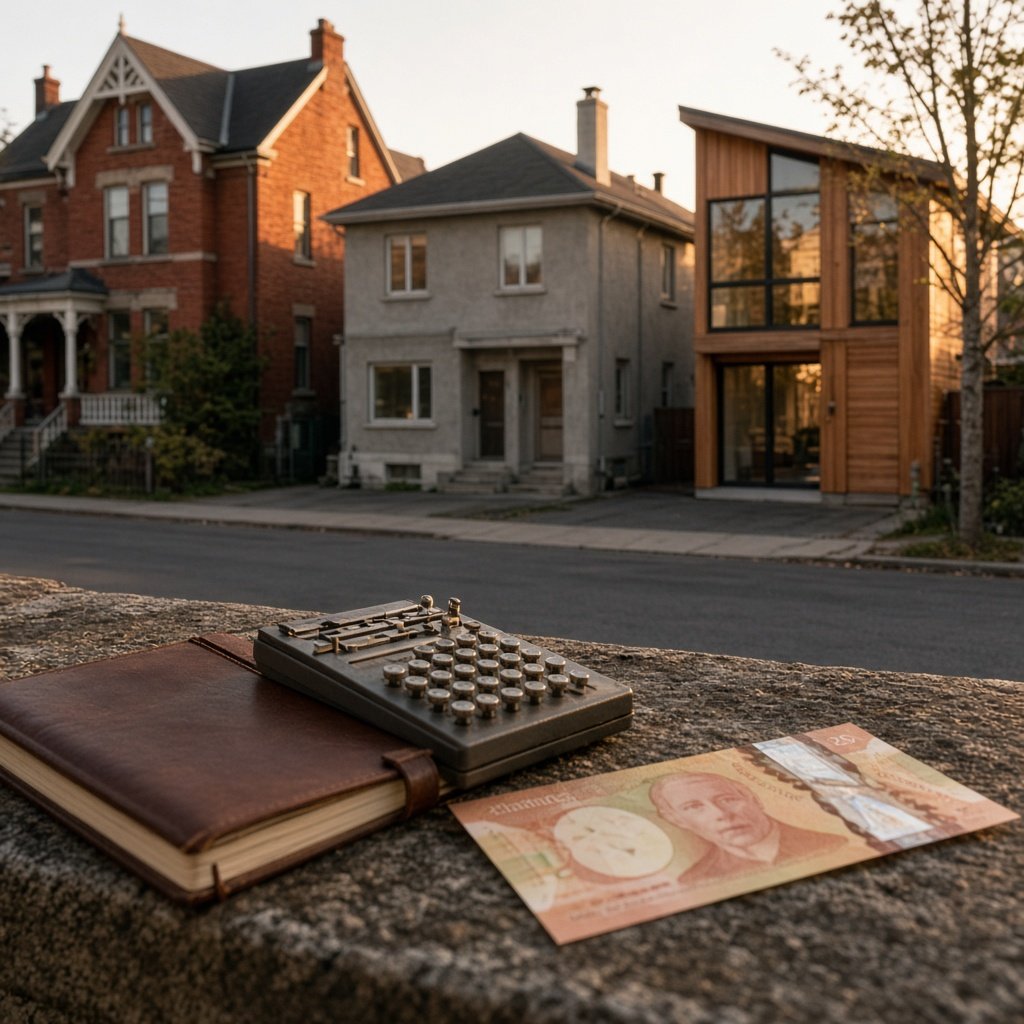
Scaling direct rentals is leverage plus concentration plus a second job. The tax treatment of each door, principal residence versus rental, is the principal residence guide. The transfer tax on every purchase is the closing cost guide. This article is the arithmetic that has to work before either of those is interesting, and the assumptions that knock it over.
Net operating income ignores the mortgage. Cap rate ignores the mortgage. Cash flow is what is left after the mortgage. Cash-on-cash divides that leftover by the cash you actually wrote. People who advertise a return by adding principal paydown to cash flow are mixing a balance-sheet item with a cheque. Keep them in separate columns.
The four numbers
| Metric | Formula, in words | What it is for |
|---|---|---|
| Net operating income | Rent, minus a vacancy allowance, minus operating costs you pay: tax, insurance, maintenance, management, utilities that are yours. Do not subtract the mortgage. Do not subtract income tax. | The building's performance before financing. This is the honest top line. |
| Cap rate | Annual NOI divided by the purchase price, or by current value if you are looking at a sale | A comparison across buildings. A high cap rate is not a high return if the roof is the reason the price is low. |
| Debt service coverage | NOI divided by the annual mortgage payments | Whether the building pays its own loan. Below 1.0, your salary is the tenant. |
| Cash-on-cash | Annual pre-tax cash flow after debt service, divided by cash invested: down payment, closing costs, and the repairs you do before the first tenant | The return on the dollars that left your account. It is before income tax and before the capital repair you have not reserved for. |
Purchase price $500,000. Down payment 20 percent, so $100,000. Closing costs in this picture are $12,000 cash, so $112,000 leaves your account. NOI is $1,900 a month after a vacancy allowance and operating costs, and before the mortgage and before any capital reserve: $22,800 a year. Cap rate is $22,800 divided by $500,000, or about 4.6 percent. Debt service in the calm case is $1,750 a month, $21,000 a year. Coverage is $22,800 divided by $21,000, or about 1.09. Cash flow is $150 a month, $1,800 a year. Cash-on-cash is $1,800 divided by $112,000, or about 1.6 percent, before tax and before a new furnace. Part of the $1,750 is principal. That principal is equity. It is not cash. If this illustration feels tight, that is the point of a 4 to 5 percent cap rate with a normal Canadian mortgage. Change the price, the rent, or the payment and rerun it. Do not import these dollars into an offer.
The second and third door do not diversify the first
Three properties in one city, financed the same way, are one bet on local employment, local insurance pricing, and the interest rate at renewal. A REIT spreads buildings, provinces, and tenants. You give up leverage and control to get that. The trade is the REIT comparison. Direct ownership's advantage is the mortgage a bank will put on a specific building, and the work you will actually do. If you will not do the work, price a property manager as a percentage of collected rent plus a leasing fee. Get the contract. Do not use a remembered percentage from a podcast as the expense line.
The usual scale-up is to refinance the first property when it has appreciated, pull equity, and buy the second. That works while appraisals cooperate and while the new loan still covers. It fails when the appraisal comes in flat, the lender's qualification rate is the contract rate plus a buffer or the current regulatory floor, whichever is higher, and your salary no longer supports three payments under that stress test. The equity you "have" on paper is not a down payment until a lender and an appraisal say it is.
A debt-service ratio just above 1.0 means one soft month of rent, one insurance increase, or one property-tax reassessment after the purchase pushes the building into deficit. Lenders look at this for a reason. You should look at it without the principal-paydown column hiding in the return.
Where the math breaks
- Renewal. In the illustration, debt service of $1,750 becomes $2,200 if the rate resets higher on a similar balance. NOI is still $1,900. Coverage falls below 1. The deficit is $300 a month before a repair. The building did not change. The contract did. Three doors with the same shape are $900 a month, funded by your job.
- Vacancy stacked on the renewal. A one-month vacancy on top of a thin NOI is not "4 percent, as modelled" if two units turn over in the same winter. Model two months. If the deal only works at full occupancy, it does not work.
- Capital repairs. A roof, a boiler, or a special assessment of an illustrative $12,000 erases several years of the $1,800 cash flow in the calm case. Condos hide this in the reserve fund until they do not. Read the status certificate. The closing guide covers that document.
- Tax reassessment and insurance. The purchase price is evidence of value. Next year's property tax may notice. A water claim in a condo building reprices everyone's insurance. Neither shows up in last year's listing sheet.
- Rent regulation. You do not set next year's rent by the spreadsheet. Provinces publish guidelines, and some units are exempt from them on specific statutory dates. Budget the rule that applies to the unit you are buying.
- Vacancy taxes. British Columbia's speculation and vacancy tax, and municipal vacant-home taxes in some cities, are aimed at empty homes. A condo between tenants can be an expensive vacant condo. Confirm the declaration rules before you leave it dark.
- Income tax on the surplus, and no deduction for principal. Net rental income stacks on your salary at your marginal rate. Principal paydown is not an expense. Capital cost allowance can shelter income and comes back as recapture on sale. The principal-residence article is the recapture warning.
- A price decline on leveraged equity. Twenty percent down means a 10 percent price drop cuts your equity roughly in half, before selling costs. Three such properties, bought with refinanced equity, can wipe the cash you put in without any one building "failing." You still owe the mortgages.
- Your time. Three tenants, three appliances, and a job. The return that ignores your hours is a return for someone else.
NOI falls to $1,500 a month because one extra month of vacancy and a tax increase landed together. Debt service is $2,200 after renewal. The monthly deficit is $700, or $8,400 a year, and then a $12,000 special assessment arrives. One door wants $20,400 of cash that year. Three doors, if you were unlucky in parallel, want a multiple of that. You cannot sell a bathroom to pay it. The calm-case cash-on-cash of 1.6 percent was not a margin of safety. It was a rounding error. These figures are a teaching stress, not a prediction of your renewal rate.
Take a capital reserve out of NOI before you declare cash flow. One percent of property value per year is a common mechanical placeholder for a house. It is not a law, and a new condo may need less while an old duplex needs more. A model with a zero reserve is a model that plans to use your salary as the reserve.
When a second property still earns its place
Buy the second door when the first one covers its payment at a rate higher than today's, with two months of vacancy, with a reserve, and with cash left over that you do not need for your own housing. Use a down payment you did not borrow from a credit card. Keep the mortgage deductible tracing clean if you finance it with equity from your residence. And decide, before the third door, whether a corporation helps or only adds a T2. Most small portfolios should stay personal. The test is the incorporation guide.
If the honest stress case requires your salary every year, you do not have an investment portfolio. You have a leveraged bet on appreciation. Appreciation can be the reason to own. It should be written down as the reason, next to the taxable gain you will owe if the property is not your principal residence. It should not be disguised as monthly income.
Key takeaways
- NOI and cap rate ignore the mortgage. Cash flow and cash-on-cash do not. Principal paydown is equity, not spending money.
- Coverage just above 1.0 is a warning, not a green light to buy the twin of the same building.
- Renewal, vacancy, and a capital repair in one year are the base case you should be able to fund. The calm year is the lucky case.
- Refinancing to scale works until the appraisal or the stress test says no. Paper equity is not a down payment.
- Three local properties are one concentration. A REIT is the diversified, unlevered, liquid alternative, with its own tax character.
- If the stress case needs your salary, you are betting on price. Say so, and remember the gain is taxable if it is a rental.
The spreadsheet is not the T776.
Net rental income, capital cost allowance, and recapture hit a return that also has a salary. The 2026 tax guide is how that stack is taxed.
Get the 2026 Tax Guide — $49 CAD